Redesigned Flight Blookings
Improving clarity, quality and trust for corporate travellers and travel managers.
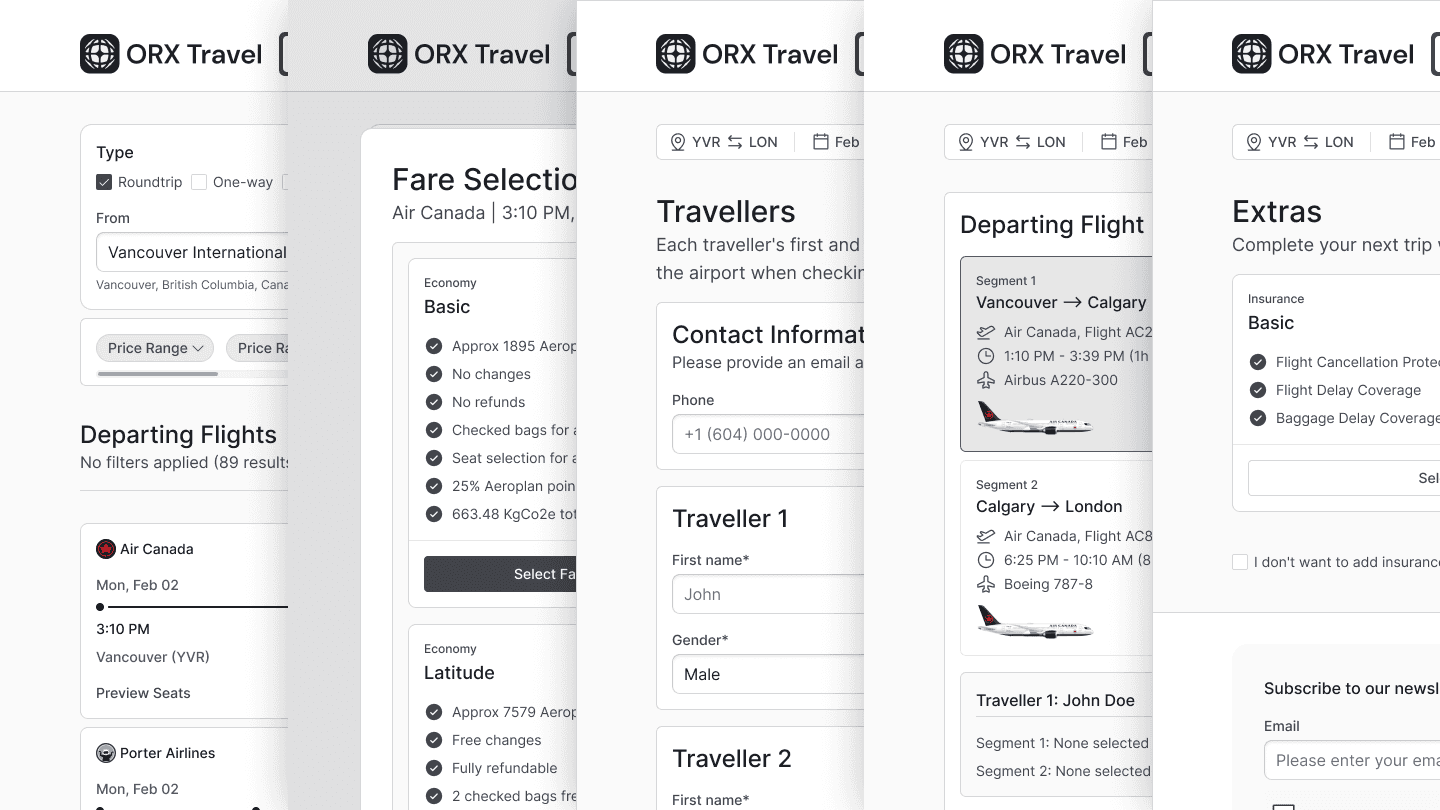
Simplified booking flow
25% quicker booking time among early testers
Reduced cognitive load
100% completion rate among early testers
Team
Noah Mah, Product Designer
Homer Li, Full-Stack Developer
Parsa Safavi, Full-Stack Developer
Timeline
2025 to Present
Status
Currently in development
Overview
A flight booking experience that hadn’t evolved in over three years was frustrating users with long load times, excessive scrolling, and unclear interactions, leading many to leave the booking site and call agents instead. By rethinking how information was structured, loaded, and interacted with, I designed a faster, more predictable booking experience that reduced completion time and improved early funnel progression. This work balanced immediate UX wins with long-term system constraints, aligning user needs, business goals, and technical realities into a scalable solution.
The Problem
The flight booking flow at ORX Travel was creating friction for both users and the business. Corporate travelers struggled with excessive scrolling, unclear interactions. and slow-loading search results. Sometimes searches could take up to 15 minutes on large search requests. This would push users away from their online bookings and towards calling in to complete them. Key clients like BNW Travel reported that some their customers found parts of the app confusing, while internal stakeholders worried that outdated design and poor information hierarchy were causing decision fatigue and reducing booking completion. With minimal UI updates in three years, the platform risked falling behind competitors, directly impacting user retention, revenue, and client satisfaction.
Roles & Constraints
I led the redesign of the flight booking flow end-to-end, owning research, UX strategy, interaction design, prototyping, and handoff to development. I worked closely with cross-functional partners, including clients like BNW Travel, internal founders and investors, and the engineering team, to align on priorities, validate assumptions, and ensure technical feasibility.
The project faced several constraints. Technically, the platform aggregated flight data from multiple sources (GDS and NDC providers), each with inconsistent formats and limitations, and the legacy frontend had rigid component rules that restricted flexibility. We also had to maintain white-label functionality, preserving certain features for corporate clients while simplifying the default experience for most users.
Our team was divided between rebuilding the frontend frontend from scratch and making incremental improvements to the existing experience. I found a compromise and suggested we follow both approaches. We invest time into making UX improvements that are technically achievable without major compromises right away. Simultaneously, we'd work on building a new frontend and components with a design system refresh in mind.
Timeline constraints were flexible; stakeholders approved a dual-track approach to deliver immediate UX improvements while planning for the future. In an ideal world, we would've focused our full team's effort into building a new frontend that would deliver a better user experience and faster development cycles. However, the product's business goals needed to be considered. We needed to meet the needs of our users to prevent further alienation and start building stronger retention.
Process
The redesign required balancing user needs, business goals, and significant technical constraints. I approached it not as a linear design exercise, but as a problem-solving process grounded in real product trade-offs.
Diagnosing the Experience
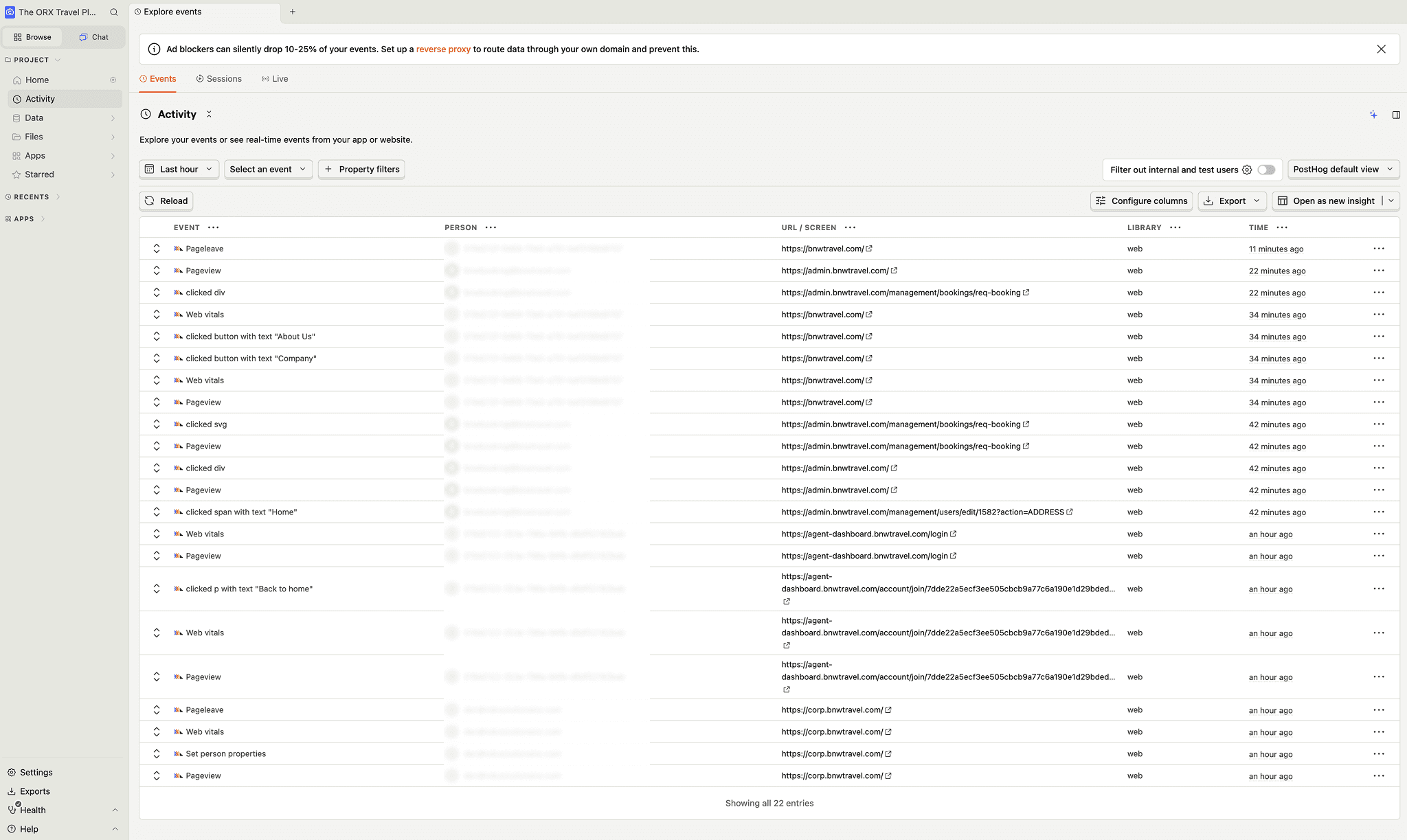
I started by reviewing the existing flow with both internal stakeholders and existing users. Using PostHog, I reviewed hours of real user activity and mapped where users dropped off, how long search results took to load, and points of friction such as excessive scrolling, poor visual hierarchy, and unclear actions.
Prioritizing Improvements Under Constraints
Given the legacy frontend and inconsistent APIs, I had to make deliberate trade-offs. For example, we couldn’t display every piece of airline or policy data in the same way without big formatting workarounds. I decided to simplify the default experience for most users while building feature flags for more advanced admin functionality, ensuring clarity without alienating stakeholders.
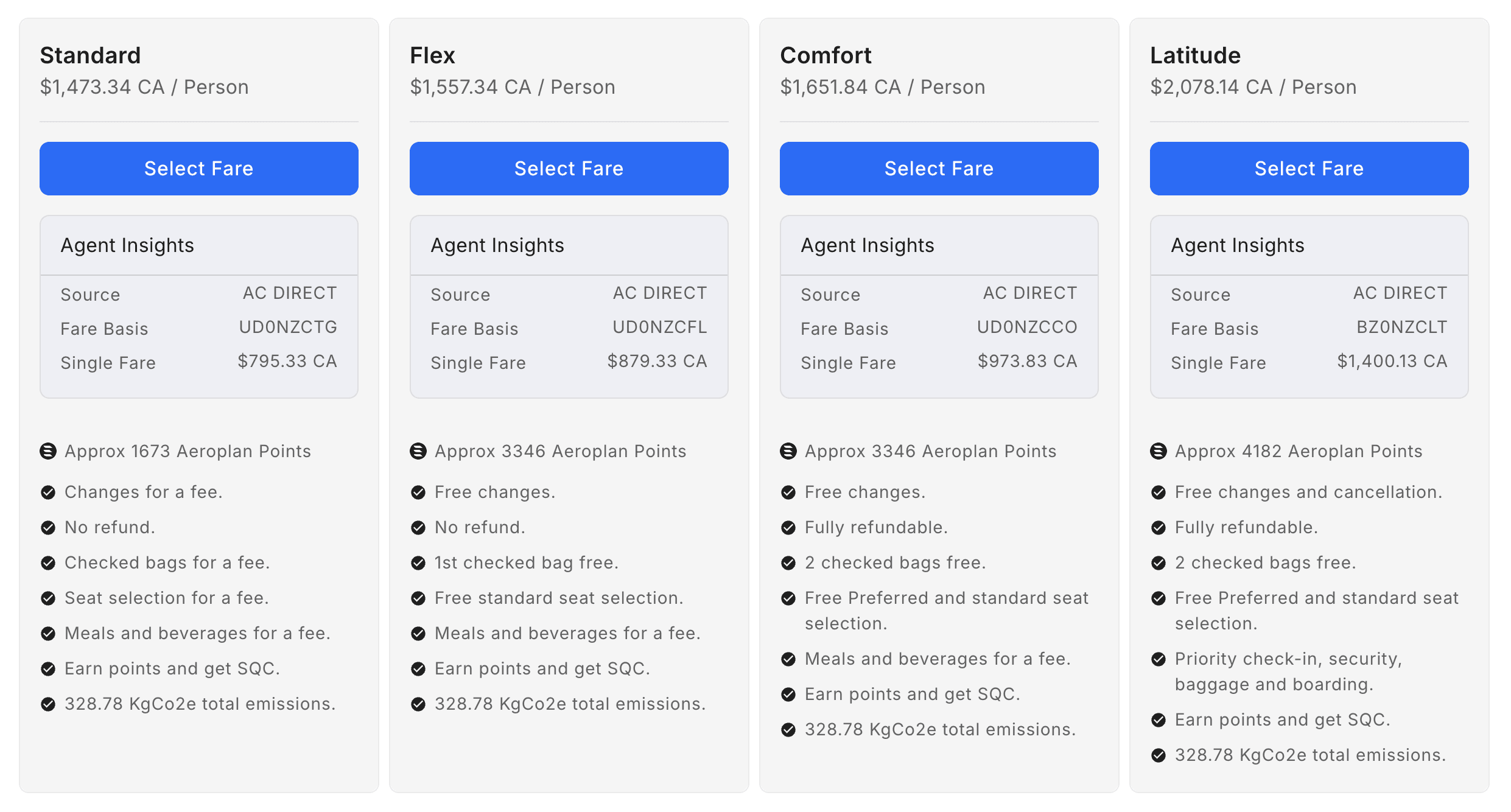
(Agent Insights are customized through a JSON file managed by organization admins, insights have granular controls and can be made unique to each agent)
Improving System Feedback & Interaction
One early decision was to implement streaming search results rather than waiting for all results to load. This required close collaboration with engineering to understand API limitations and workarounds. The trade-off was that not all fields could be displayed immediately, but it drastically reduced perceived load times and prevented user abandonment. We made sure to use skeletons, tool tips, animations and various loading states on elements to effectively communicate what's been loaded to the user.
Designing for Scanning & Efficiency
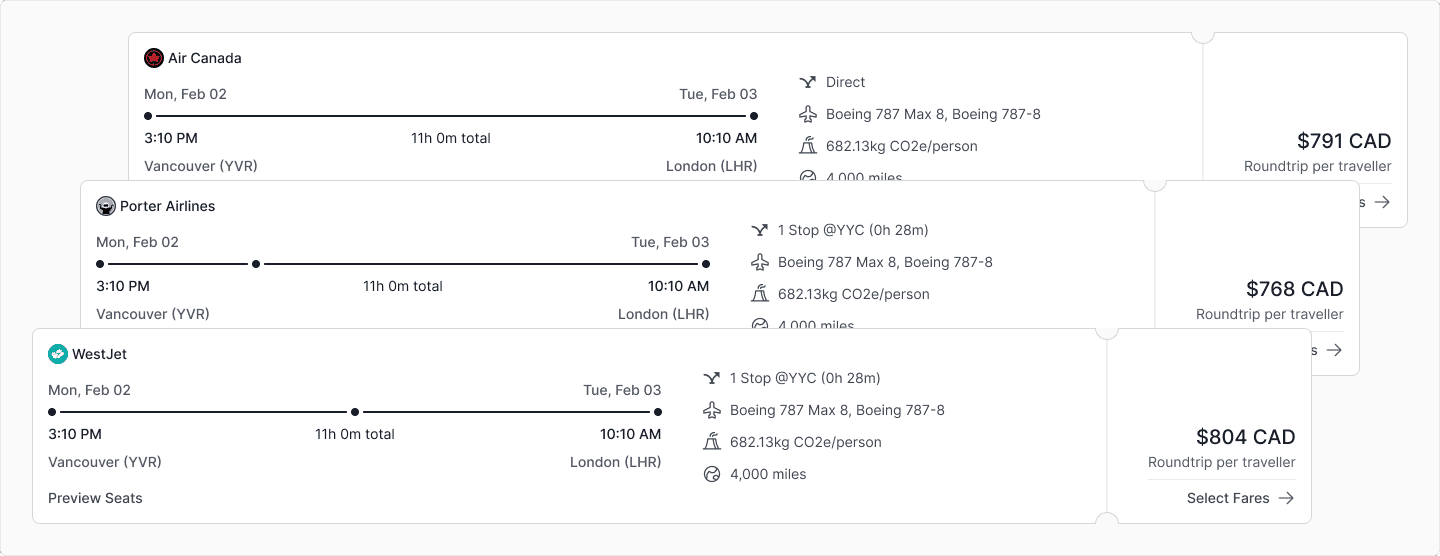
To reduce scrolling, I restructured search results to increase visible density without compromising readability. I anchored filters and key actions in persistent positions so users could access them at any point, reducing back-and-forth navigation. Every layout choice was weighed against technical feasibility, screen size variations, and white-label requirements.
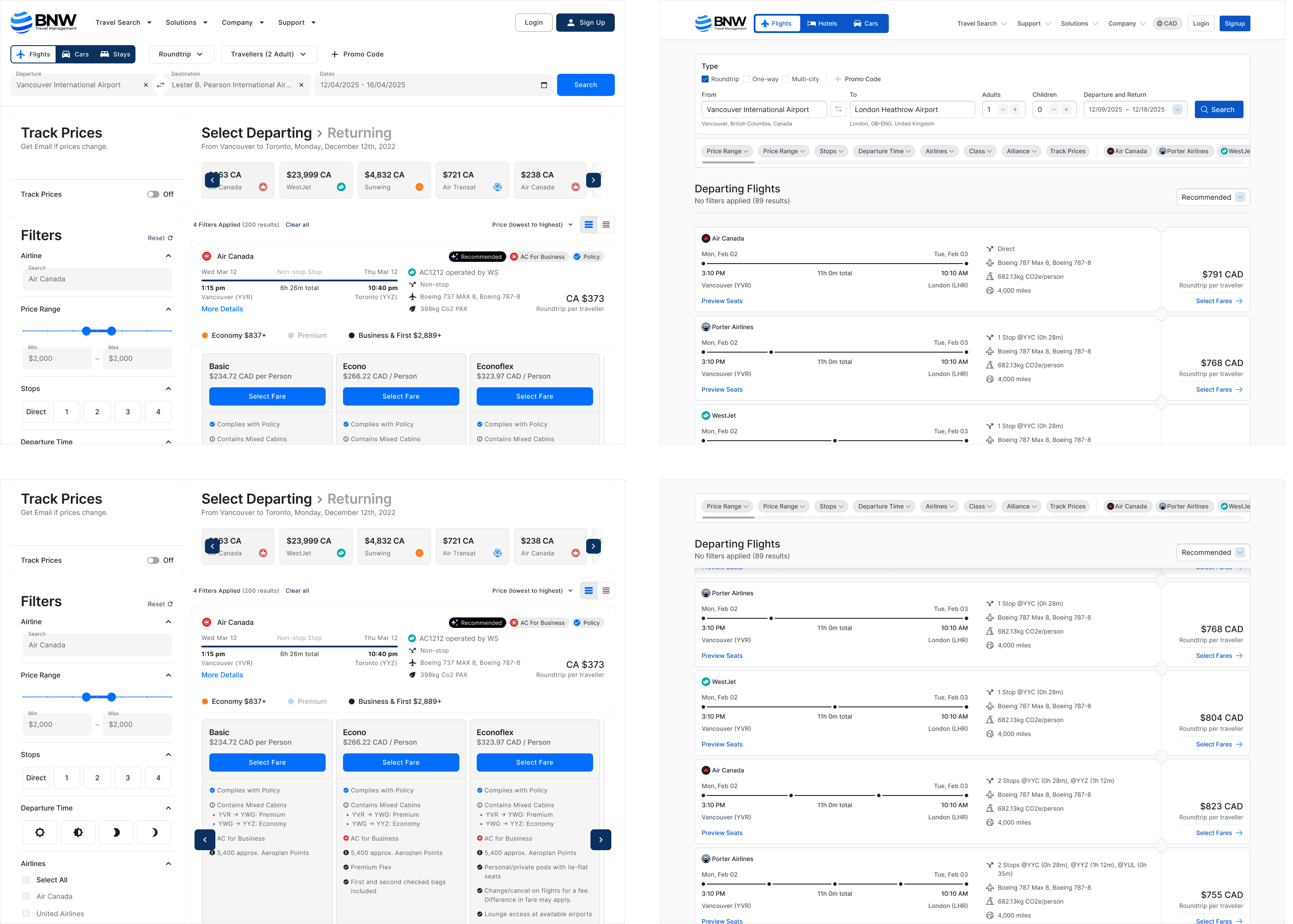
(Old search results on left and new results on right)
Iteration & Validation
Prototypes were tested with users and stakeholders, revealing small but critical misalignments in flow predictability and interaction clarity. For instance, testing showed that the micro-interactions like hover states, tooltips, and loading animations we added helped users feel more in control. Adjustments were made iteratively to balance user comprehension, technical complexity, and development effort.
Parallel Strategy for Short- & Long-Term Impact
Recognizing the limitations of the legacy frontend, I recommended a dual-track approach:
Implement immediate UX improvements within the existing system for fast wins
Begin rebuilding the frontend to allow full design flexibility in the long term
This approach ensured the project delivered tangible impact now while positioning the platform for scalable growth in the future.
Key Design Decisions
Streaming Search Results vs Full Load
Problem: Users were waiting minutes for search results to load, leading to abandonment and frustration. Before my time with ORX, the product team decided load times were not a priority. There was a lot of developer cost in implementing a streaming approach and other features needed more development. The product was mostly used by corporate travel managers and agencies who had experience with GDS tools like Sabre. Most managers were okay with a slower loading experience at the time. Today, more companies are empowering their teams to create bookings without going through a manager. The slow load times were no longer viable in today's environment.
Options Considered:
Keep full aggregation before displaying results (status quo)
Stream results progressively as they became available
Decision: Implement streaming search results with progressive rendering, showing partial results immediately while additional results loaded in the background.
Impact: Reduced perceived load time drastically, leading to a 50%+ improvement in progression from search → seat selection during early release. Users felt in control, and abandonment decreased.
Persistent Filters and Anchored Actions
Problem: Users had to scroll back and forth to adjust filters or take key actions, creating friction and slowing the booking process. The search and filter features on the platform were split between a horizontal search bar and a vertical sidebar. Some filters were even duplicated in both UI components.
Options Considered:
Keep filters in their existing location (as a long sidebar)
Collapse filters into a modal
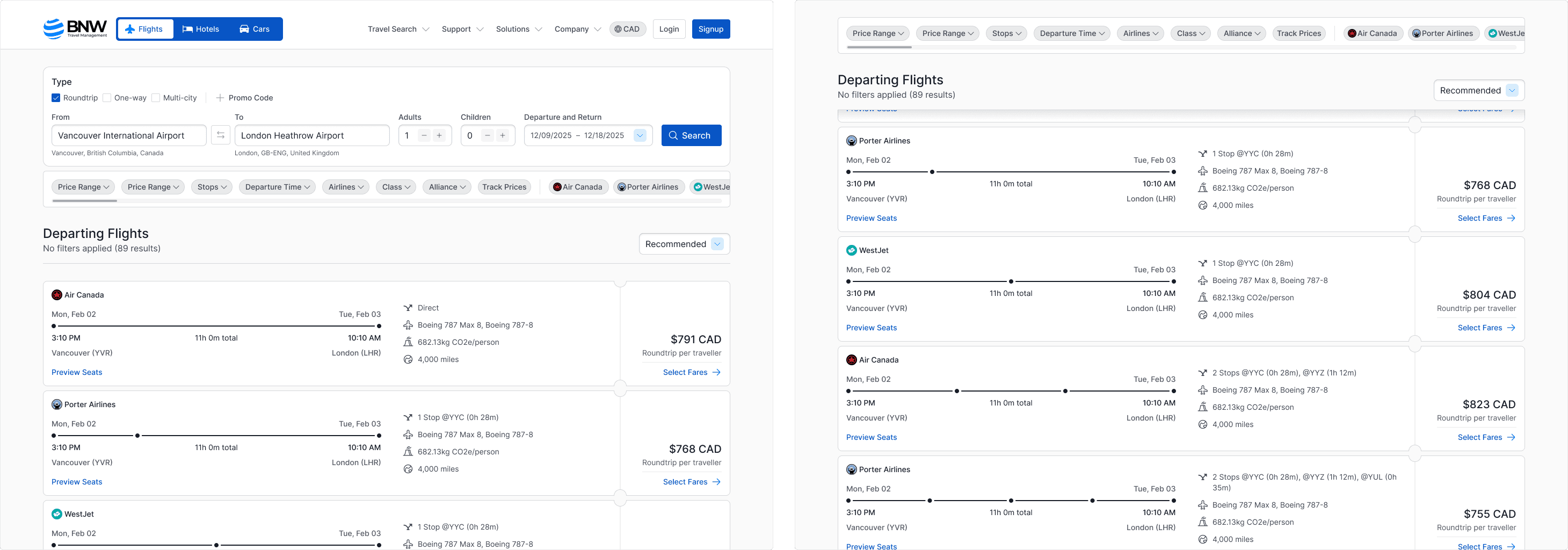
Anchor filters and key actions in fixed positions on the top of the page
Decision: Anchor filters and key actions so they were always accessible without scrolling.
Impact: Reduced navigation friction, sped up complex bookings, and improved usability feedback, especially from corporate travellers managing multi-step searches.
Minimizing Unnecessary Steps
Problem: Legacy UI overloaded users with countless pages loaded with options. This problem is not exclusive to our product. Many online booking platforms (especially B2C options like Expedia) have large and complex booking flows.
Options Considered:
Keep all existing pages
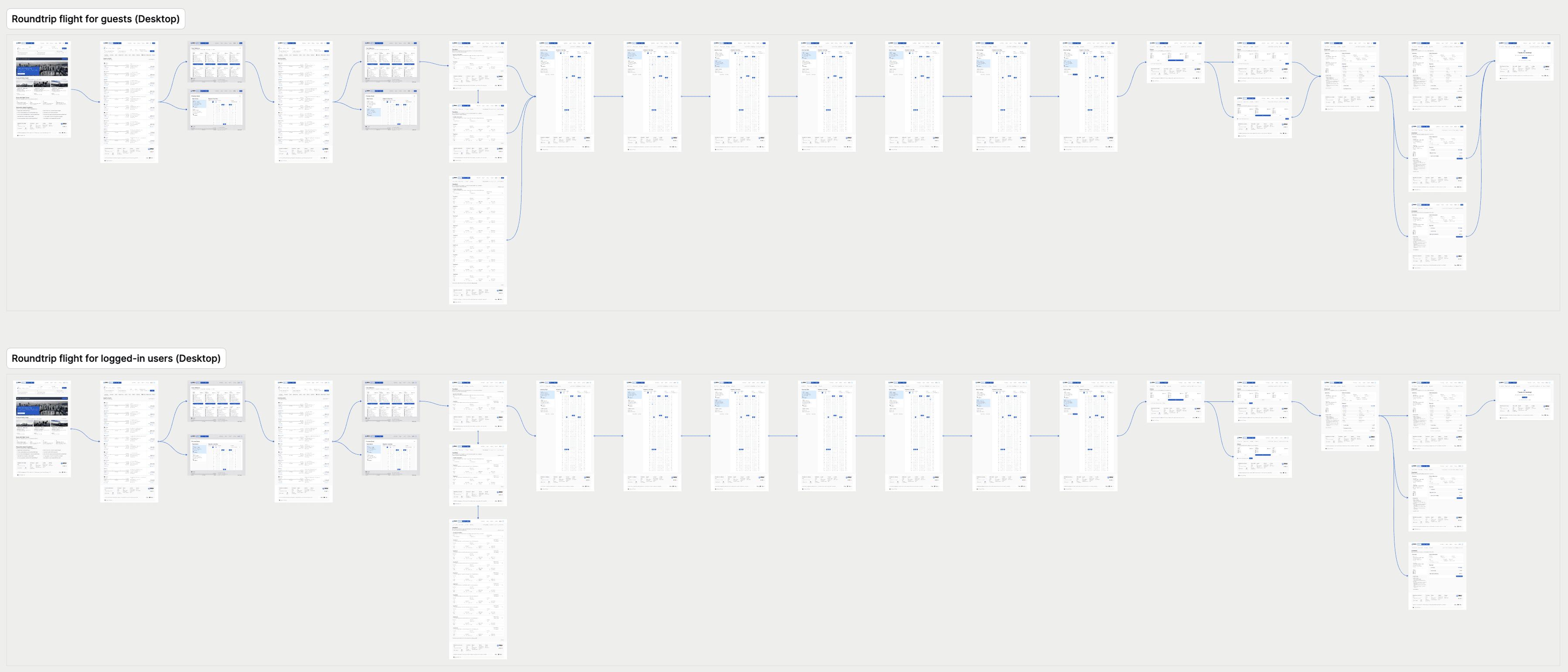
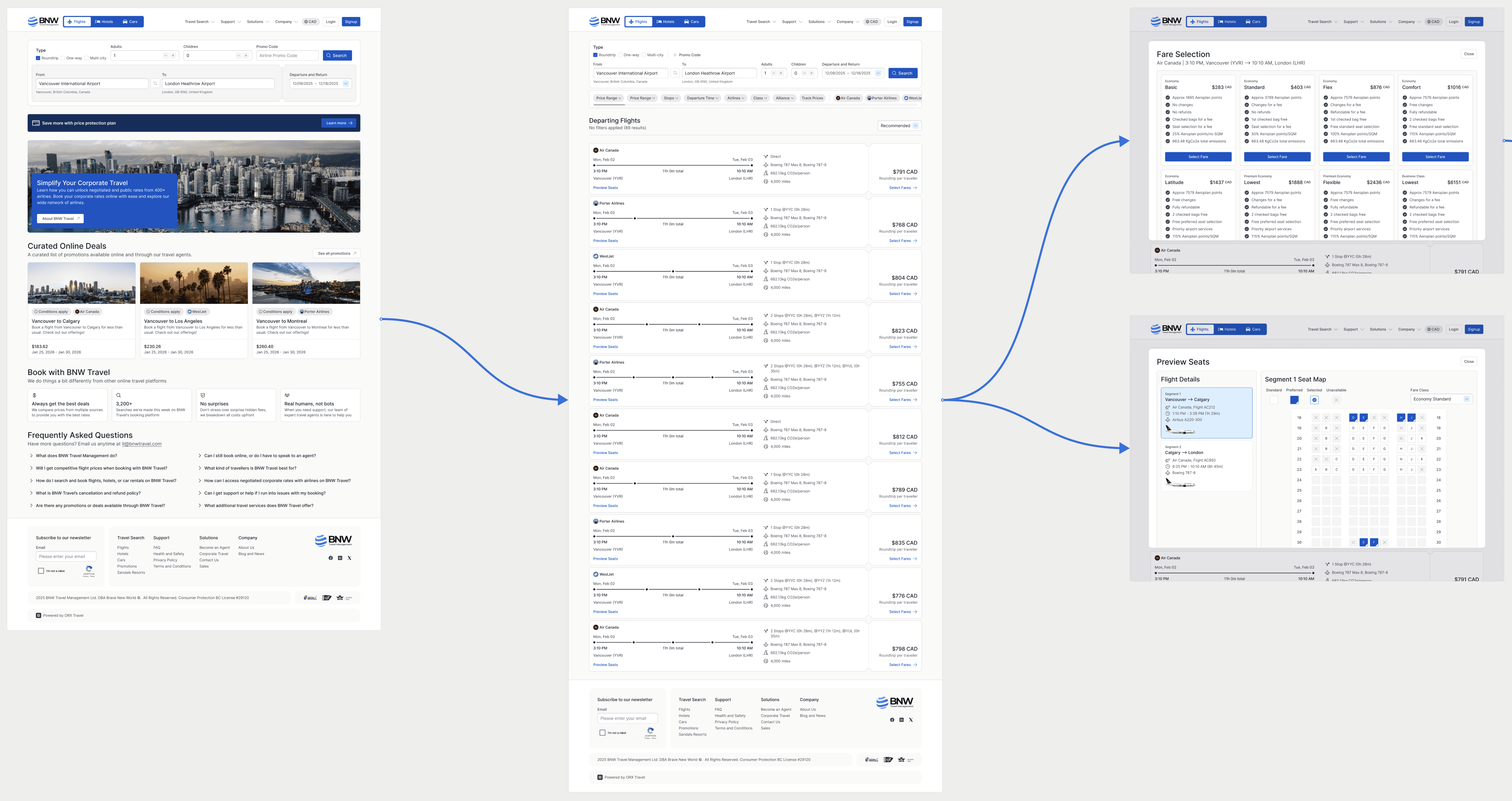
Simplify booking flow and combine relevant pages
Decision: We decided to reorganize all the content and features of each page to create a streamlined flow for users.
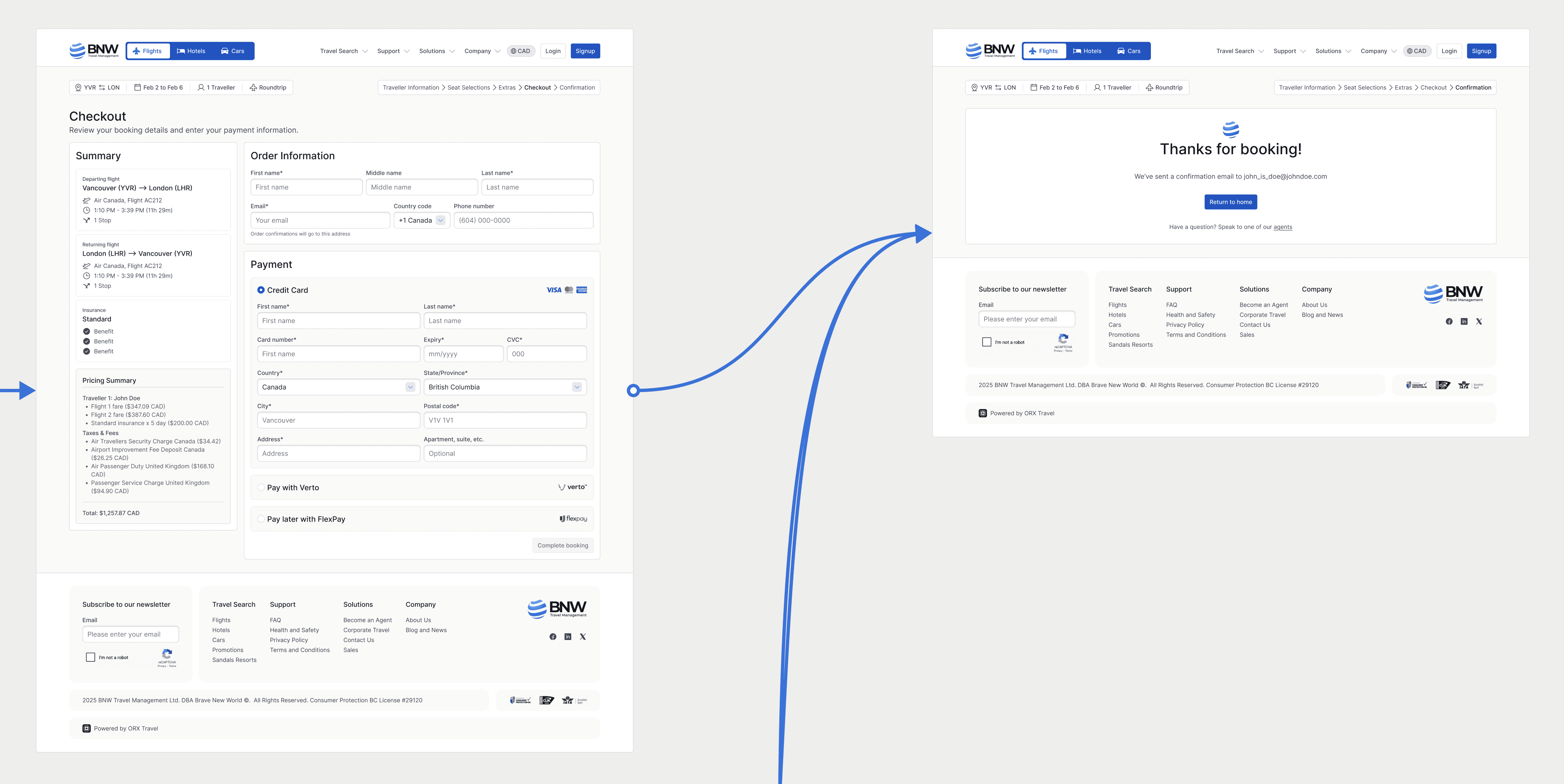
Impact: Improved the experience for users without losing functionality by reducing pages and organizing options with similar groupings. This reduced cognitive load and decision fatigue while preserving essential functionality. The new flow also gives a competitive edge with other online booking tools that still use bloated booking flows.

Outcomes & Impact
The redesign had measurable impact across business, users, and the product team.
Business Impact
The early release of streaming search results led to a 50%+ improvement in users progressing from search to seat selection, demonstrating a significant lift in conversion potential. By streamlining the booking flow, we reduced reliance on agent-assisted bookings, helping our users from BNW Travel lower operational costs and support load. The refreshed experience positions the platform to remain competitive with modern booking solutions, strengthening client satisfaction and retention.
User Impact
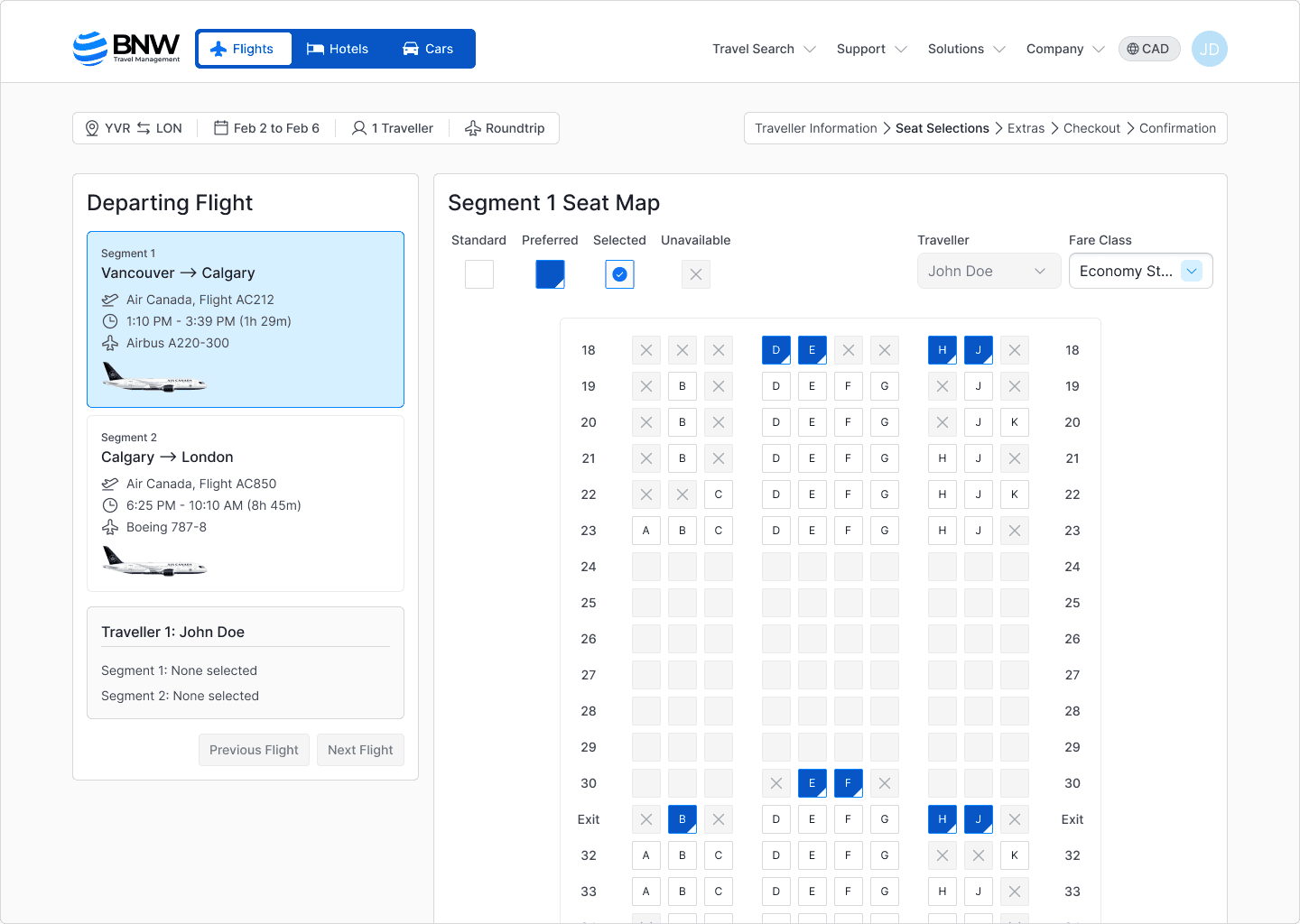
Users were able to complete bookings faster, reducing cognitive load and frustration. In prototype testing, we had test users try a handful of common booking scenarios. The test bookings were completed 25% quicker, and 100% of participants successfully finished tasks without guidance. Anchored filters and improved visual hierarchy minimized excessive scrolling and back-and-forth navigation, making complex bookings more efficient. Testers described the experience as “straight to the point,” “transparent,” and “delightful,” reflecting both improved usability and satisfaction.
Team & Organizational Impact
The new UI simplified development, reducing complexity and making future enhancements easier and more predictable. Design decisions were made collaboratively with stakeholders and engineers, aligning everyone around a shared vision for the booking flow. The project also triggered a broader refresh of the design system and frontend architecture, creating a more scalable foundation for future growth and reducing long-term technical debt.
Early Indicators & Anticipated Impact
While full rollout metrics are pending, early testing and prototyping suggest strong positive trends:
A potential 20–30% increase in booking completion once the full redesign is live
Time-to-book is expected to decrease by roughly 25% for most users
System feedback improvements and micro-interactions are projected to lower support inquiries and reduce operational workload
Reflection
Meaningful UX impact doesn’t come from adding more features, but making intentional decisions to suit a product's goals. By focusing on speed, clarity, and system feedback, I was able to unlock measurable gains without waiting for a full rebuild.
This work shifted how I approach complex systems: prioritizing perceived performance as much as actual performance and treating constraints not as blockers, but as inputs to better solutions.